

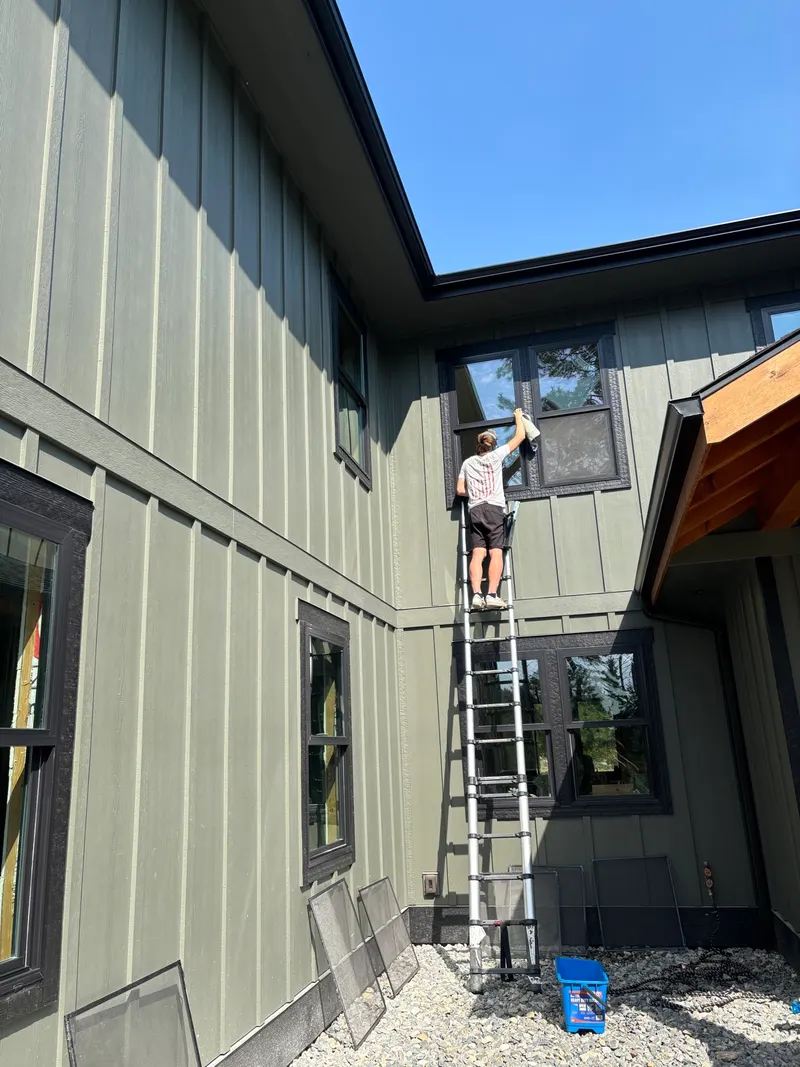
Why height changes the job
A ground-floor window is a cleaning problem. An upper-story window is an access problem first. Before anyone touches the glass, someone has to work out how to stand in front of it, and that answer comes from what is on the ground under the pane rather than from the pane itself.
Valley homes make that harder than it sounds. Decomposed granite shifts under a ladder foot. Gravel beds, river rock and graded slopes give nothing level to stand on. Planters, pool decks, air conditioning units, low patio roofs and bay windows tend to sit exactly where a ladder wants to go. Clear that spot and the next window has something different under it.
Hillside lots change it again. In parts of Mesa like Las Sendas, and anywhere a pad is cut into a slope, the ground under one wall drops away. A second-story window on the downhill side sits as high as a third story, and the only level footing may be several feet from the wall.
Heat and wind belong on the list too. Ladder rails get hot in direct sun, and anyone working an upper pane in the afternoon has less grip and less patience than they would have in the morning. Wind pushes a tall ladder and catches a pole. Both are reasons an upper-story visit gets planned around a time of day instead of squeezed into whatever hour is left.
Most of the work on an upper-story window happens before anyone touches the pane.
Ladder, pole or from inside?
There are three ways to reach an upper pane, and most houses need more than one of them. A pole from the ground, a ladder set below the window, or the inside face of a window that opens far enough to reach through. Which one applies changes from wall to wall.
Pole work from the ground keeps the cleaner on level footing and covers long runs of glass without resetting a ladder at every opening. It needs a clear line from the ground up to the pane. Deep eaves, patio covers, balconies, trees, light fixtures and satellite mounts all get in the way, and a pole cannot feel a stubborn spot the way a hand at the glass can. Frames, ledges and corners usually still want closer attention.
A ladder puts the cleaner at the window, which is what detailed work on divided lights, grids and transoms takes. The trade is setup time. The ladder needs level footing, the right extension for the window, and a reset for the next opening instead of a sideways lean. Leaning out past the rails is the move that tips ladders, so a careful crew moves the ladder more often than a hurried one.
Some upper windows can be done from inside. Casements that swing wide, single-hungs that tilt and double-hungs that come out of their tracks let a cleaner reach the exterior face from the floor. Most Valley patio walls, fixed picture windows and clerestory panes do not open at all, so the outside of that glass is reached from outside. Our page on exterior window cleaning covers what the outside pass includes.
What decides the approach
A cleaner looking at a two-story home is reading the walls for these things. You can read them yourself before anyone arrives.
- What sits under each upper window: level concrete, loose gravel, a slope, a planter bed, a pool deck, an air conditioning unit or a low roof
- How the pane sits in the wall, flush or recessed behind a deep eave or a patio cover
- Whether the window opens, and which way it swings or tilts
- The pitch and surface of any roof the glass can only be reached from
- Divided lights, grids, transoms and arched tops, which take individual work at the pane
- Screens on the upper openings, and whether any frames are brittle or torn
- Trees, wires, cameras, lights and mounts between the ground and the glass
- Wind and time of day, since both change what is safe at height
Those same details are what make an upper-story visit longer than a ground-floor one. Height is one of several factors behind a written quote, and our guide to what shapes a window cleaning quote walks through the rest of them.
What to check from the ground
Walk the outside of the house once, in the morning or late in the day when the light is low and across the glass. Low light shows film and spots that disappear at noon.
Look for upper panes that are hazier than the rest. A window above a sprinkler zone or a pool collects mineral spray that dries in place, and it will look worse than the glass beside it. If those spots stay visible after a rain, mention them at quote time. Surface film and etched glass take different work, and the hard water stain removal page sets out which one can be improved and how far.
Check the upper screens from below as well. Desert dust loads into the mesh and goes straight back onto clean glass with the next breeze, so screens that have not come out in years are part of the job rather than an extra. Brittle frames are worth flagging before anyone handles them, and the screens, tracks and sills page explains how they come out and go back in.
Should you do it yourself?
Ground-floor glass is reasonable to take on. So is a pane above a patio when you can stand on level concrete and work with an extension pole, and interior upper glass you can reach from a step ladder on a flat floor.
Upper exterior panes are a different question, and the risk is the fall rather than the streaks. A long ladder on desert gravel, a bucket in one hand, a reach sideways to get the far corner, and a surface that is wet by the time you come back down. Follow the labels on your own ladder, and if a window needs anything that those labels rule out, it is work for someone set up for height.
Roof access deserves its own line. Tile breaks underfoot, pitch is harder to judge from the ground, and a hot roof surface is slick with grit. A pane that can only be reached by standing on a roof is not a weekend task.
What to tell the cleaner
The more of this a cleaner knows before the visit, the less gets discovered from the top of a ladder.
- How many stories, and roughly how many upper panes
- What is underneath each one, especially pool decks, planters and equipment
- Whether the lot slopes, and which wall is on the downhill side
- Whether the upper windows have screens, and whether any are damaged
- How wide the side gate is, so a long ladder can reach the back yard
- Any pane that has not been cleaned since the house was built
- Wide photos of each side of the house, taken from far enough back to show the whole wall
Camelback Window Cleaning asks about high and hard-to-reach glass on the instant quote, so the scope is written down before a crew is scheduled. The exterior pass covers every pane, frame and ledge in that scope, screens are removed, washed and reinstalled, and the crew texts before arriving. If an upper pane cannot be reached safely, the quote is the right place to hear it rather than the morning of the visit.
Key takeaways
- Upper-story glass is reached by pole, by ladder or from inside, and most homes need more than one approach.
- The ground under the window decides more than the window does.
- Hillside lots turn a second-story wall into a third-story reach.
- Upper screens hold dust that comes straight back onto clean glass.
- Flag high glass, slopes and pool decks at quote time, with wide photos of each wall.