

Tinted glass or film?
Two different things get called tinted windows. Some glass is colored at the factory, with the tint running through the pane itself. Other panes are plain glass with a thin film applied to one face later, either by the builder or by somebody the owner hired. From across the room they look the same. Up close they behave nothing alike, because film can be cut, scratched and peeled and a tinted pane cannot.
The difference only matters when somebody is holding a blade or a stiff pad against the glass, which is why most people never learn which one they have. A look along the edge of the glass settles it.
How to tell what you have
- Look where the glass meets the frame. Applied film is usually cut a little short of the frame, so a thin line of clear glass shows around the edge.
- Run a fingertip around that perimeter. A film edge has a lip you can feel. Factory tinted glass runs smooth into the frame with nothing to catch.
- Check for bubbles, creases or a corner lifting away from the pane. Glass does none of that. Film does.
- Look for a purple or coppery cast on one window that the rest of the house does not have.
- Compare elevations. If the glass on one side of the house is darker than the rest, something was probably added to it after the build.
- Treat frosted and privacy panels in bathrooms and entries the same way. Those are often film too, and they are the easiest kind to mark.
- If none of that settles it, look for paperwork from the build or the installer rather than testing the glass with a blade.
Film sits on the surface of the glass, so whatever touches that face touches the film.
Which face the film is on
Most applied film goes on the interior face of the glass. Inside, it is out of the sun, out of the dust and out of reach of a hose, which is where a thin layer lasts longest. For most homes that means the outside of the window is ordinary glass that takes a normal exterior window cleaning pass, and all of the careful work happens indoors.
Exterior films do exist, and here they live a hard life, with sun on them every afternoon and grit blowing against them. If any of your glass carries film on the weather side, that is the first thing to mention when you book. It changes what may touch the pane and it changes what can be done about mineral spotting.
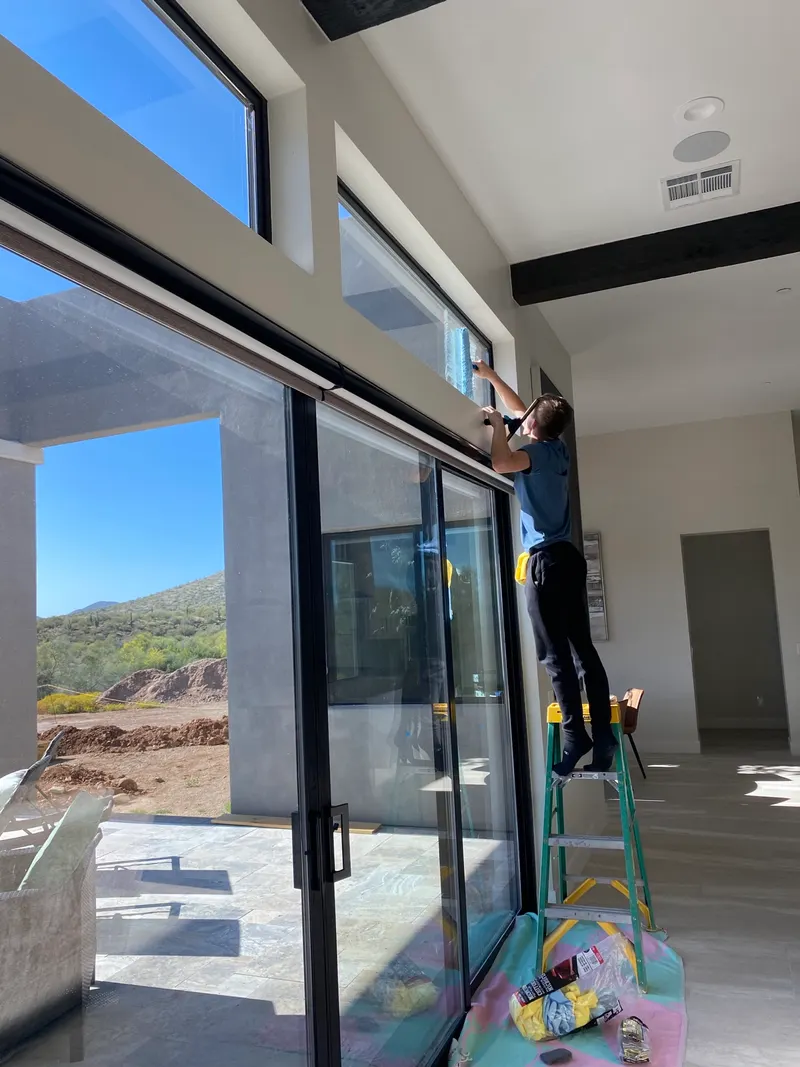
Interior window cleaning is where most of this lands. A crew working inside is already moving slowly, laying drop cloths and finishing by hand, so a filmed face is one more thing to work around rather than a different kind of job.
What actually marks film
Washing does not hurt window film. Tools do. Every item below is routine on plain glass and a problem on a treated pane.
- A scraper blade. The pass that lifts dried paint off bare glass will cut, gouge or peel film instead.
- Abrasive pads, scouring powder and the white foam eraser pads sold for scuffs. They all work by sanding the surface, and on a filmed pane the surface is the film.
- Ammonia based sprays, which can attack the film and the adhesive holding it to the glass. This is the one that catches people out, because it is the bottle already under most kitchen sinks.
- Acidic hard water treatments, which are built to work on mineral deposits and on glass, not on a coating laid over them.
- A dry cloth dragged across a dusty pane. The grit is harder than the film, so the wipe does the scratching.
- A cloth pushed over an edge that is already lifting, which peels it a little further every time.
- Suction cups, hooks and tape stuck to the treated face and then pulled off.
What is left once you set those aside is a soft cloth, a mild cleaner and some patience, which handles fingerprints, dust and nose prints anyway. Our post on why interior glass hazes in Phoenix homes covers the greasy layer that builds on an inside pane over a season. That is a different sort of film, and it comes off with the same gentle approach.
Hard water and film
Sprinkler overspray dries on the outside of the glass and leaves minerals behind, and this is the one problem where the face the film is on decides the whole approach. If the film is inside, the exterior pane is ordinary glass and mineral treatment goes ahead the way it would on any window. If the film is outside, a treatment meant for bare glass may not be right for it, and the care instructions from the installer have to settle the question before anything is applied.
Mineral buildup is also the thing most often mistaken for film going bad. A chalky white haze low on the outside of a pane, in an arc that matches where a sprinkler head points, is a water problem rather than a film problem. Wet a small patch and watch it. Deposits usually look clearer while wet and cloudy again as they dry. Hard water stain removal is handled as separate work for that reason, and treating hard water on pool side glass goes through what improves and what does not.
When film is past help
Some treated windows cannot be improved by cleaning them, and it helps to know the signs before you book so nobody spends the visit scrubbing at something that was never dirt.
Bubbles spreading across a pane are the adhesive letting go. Creases and a lifted edge are the same story further along. A purple or coppery cast means the film itself has changed in the sun, and it tends to show first on the elevation that takes the most afternoon light. None of that improves with a wash. It is a conversation with a film installer about stripping and replacing, and the right move for a window cleaner is to point it out and leave it alone.
Homes built around a view raise this more often than most. A wall of glass framing the McDowells or the open desert is also a wall of glass taking the full afternoon, and sun is what ages film. The Fountain Hills window cleaning page covers that area, where large view windows are the norm, and our post on west facing windows in Arizona covers what that exposure does to glass through the rest of the day.
What to tell your cleaner
A window cleaner cannot pick film out from across a room any better than you can, and on a first visit there is no way to know which panes in a house were treated and which were not. So the information has to come from you, before the work starts rather than after.
Say this before the visit
- Which rooms or elevations carry film, and which face of the glass it is on.
- Any pane where the film is already bubbled, creased or lifting at an edge.
- Frosted, etched and privacy panels, plus any applied lettering or decorative film.
- Glass replaced recently that may still carry a manufacturer label, since a label on a filmed pane cannot be scraped off.
- Where sprinkler spotting is worst, so mineral treatment gets planned on the correct face.
- Who installed the film, if you want their care instructions followed.
If you do not know the answers, say that as well. A pane treated as filmed when it turned out to be plain glass still comes out clean, and nothing is lost by erring in that direction.
Before you book
Walk the house once with this in mind. Look along the edges of the darker panes, note which rooms they are in, and check the drawer where paperwork from the build ended up.
Camelback Window Cleaning cleans interior and exterior panes, frames and ledges inside a written scope, and an interior visit starts with shoe covers at the door and drop cloths under the work. The crew texts before arriving, which is a good moment to repeat which windows are treated. We do not install, repair or remove window film or tint, so that work stays with a film installer, and the crew cleans around it.
Mention the filmed panes when you ask for a quote, and send a photo of any edge that has started to lift. Get instant quote and the written scope can say how those windows will be handled.
Key takeaways
- Two different things get called tinted glass: panes colored at the factory and film applied to one face later.
- Film almost always sits on the interior face, so the outside of the window usually takes a normal clean.
- Blades, abrasive pads and ammonia based sprays are what mark film. Washing does not.
- Bubbles, creases and a purple cast mean the film is failing, and no amount of cleaning changes them.
- Tell a cleaner which panes carry film, which face it is on, and where an edge is already lifting.