

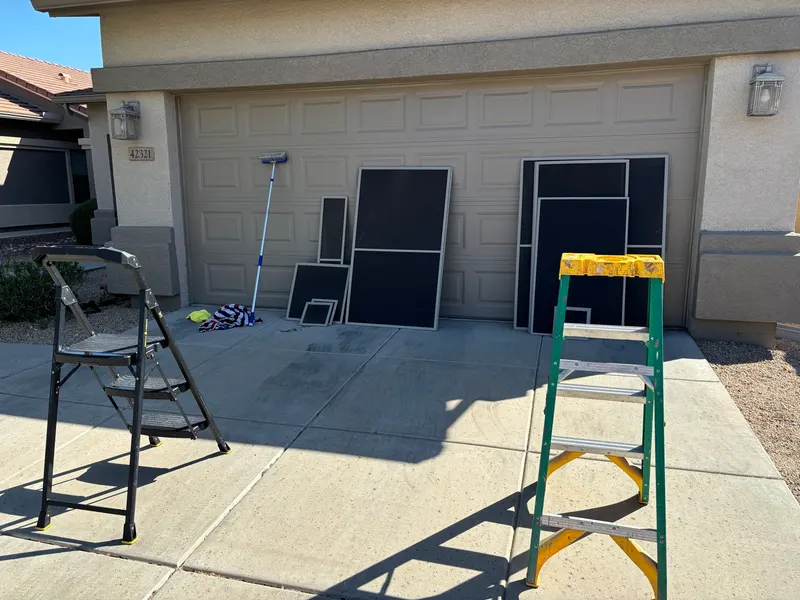
What the walk-through sees
A community walk-through happens from the street or the sidewalk, usually in one pass. Whoever is doing it takes in the elevation as a whole: paint, roofline, the yard, the driveway, the garage door and the windows across the front. Nobody opens a gate to study a single pane.
That distance decides which window problems get written up. A smudge on the inside of a bedroom window has never been spotted from a sidewalk. What does show is contrast: a torn screen in a row of good ones, a missing screen leaving one dark opening in an even line, a white mineral band across the bottom of the front glass, foil or cardboard taped inside a pane.
So judge your windows from the curb. Stand out there in the middle of the day, look at the front of the house the way a stranger would, and the list writes itself.
Walk your own elevation
- Screens with a tear, a hole, a bulge or a frame that has gone out of square.
- Missing screens, and any opening where one came out and never went back.
- Mesh that has faded or gone chalky next to the others on the same wall.
- A white or grey band low on the glass, where the sprinklers reach.
- Dust lines along the bottom rail and in the track of any slider facing the street.
- Anything taped, propped or hung inside a window that reads from the sidewalk.
- Cracked or chipped panes, and any sealed unit that has fogged between the glass.
- Frames, sills and ledges carrying dirt that stands out against the paint.
An inspector reads the front of the house from the street, which is where a torn screen shows and a smudge does not.
Read your own documents
Every community sets its own standards, and they live in the recorded documents rather than in anyone's memory. The CC&Rs carry the general obligation to keep the home in good condition. Design or architectural guidelines, where a community has them, go further and can cover materials, colors and what may be fitted to the outside of a house. The rules and regulations hold the day to day items.
Look for two things. The first is any clause about maintaining the exterior in good repair, which is usually where window and screen condition sits. The second is any clause that names windows directly: screen frame color, sun screen material, film or tint, and what may be used as a window covering. Some communities say nothing about either and some are specific, and the document is the only way to find out.
A notice, if one arrives, usually names the item, cites the section it comes from and gives a date. Start from that citation. It points at the exact standard you are being measured against, which beats guessing what the inspector had in mind.
Screens get written up
Screens wear out in the open air faster than the glass behind them. The Valley gives them sun on one side all afternoon, dust in every wind, and a dry heat that works on the mesh and on the spline holding it in the frame. After enough seasons the mesh goes brittle, a corner lifts, and one bump turns it into a visible tear.
A torn screen is the window item most likely to be noticed from the street, because it breaks a pattern. A row of good screens with one bad one is read instantly, while the same tear on the back of the house can sit for years.
Cleaning and repair are different jobs, and sorting them before you book anything saves a visit. Mesh that is sound but grey with dust comes back with a wash. Mesh that is holed, split along the spline or rotted at a corner needs a rescreen, which takes its own time. Our walk through of how to clean window screens covers what a wash fixes and what it leaves behind.
When screens come out for cleaning they go back the same visit. Screens, tracks and sills covers removing them, washing them, clearing the track underneath and refitting them, which also takes out the grit that makes a slider grind.
Glass that reads as dirty
Two things make Valley glass look poor from a distance. Dust arrives on the wind and settles as an even haze that dulls the whole pane. Mineral film comes from water drying on the glass, usually sprinkler overspray, and it lands low on the window in the shape of the arc that threw it.
The mineral band is the one that gets noticed, because it has an edge. Dust fades a window evenly and the eye forgives it. A hard white line low on the front glass looks like neglect even when the rest of the house is spotless.
Fresh mineral film usually improves with treatment. Deposits left to build for years can etch into the surface, and etched glass can be improved without ever coming back to new, which is worth knowing before a walk-through rather than after one. Hard water stain removal gets assessed on the glass itself, because the same white band can be film on one window and etching on the next.
While you are out at the curb, look at where the spray is going. Turning a head a few degrees away from the wall stops the next band from forming.
When to book the clean
Walk-throughs run on a cycle. Some communities drive the streets monthly, some quarterly, some once a year ahead of an annual meeting. Ask the management company when the next pass is due, because that date is the one that sets your timing.
Aim to have the glass finished a week or two ahead of it. The margin covers a rescreen that has to be ordered, a mineral treatment that needs a second look, and a windy afternoon putting a layer of dust back on a freshly cleaned window.
If you are already holding a notice with a cure date, work back from that date instead. Window cleaning plans exist for homes that would rather have the glass handled on a rhythm than chased before each inspection. Set the rhythm so a visit lands ahead of the cycle your community runs, and the walk-through stops being a deadline.
Season plays into it as well. Our Phoenix window cleaning calendar works through when Valley glass gets dirtiest through the year.
Rentals and empty homes
The owner is the member of the association, so notices land with the owner even when somebody else is living in the house. A tenant who never sees the letter cannot fix the screen, and an owner who is out of state for the summer cannot either.
Two practical moves cover it. Give the management company an address they can reach you at year round, and give someone local the ability to open a gate and let a crew in. A clean that has to wait for the owner to fly back is a clean that misses the date on the letter.
Homes that sit empty for a season have their own routine, which we went through in what snowbirds do about windows after summer.
Questions for your manager
- When is the next walk-through, and how often does the community run them?
- Which document and section covers window and screen condition?
- Are screen frame color, mesh type or sun screens specified anywhere?
- Is there a rule about what may be visible inside a window from the street?
- How long is the cure period after a notice, and who confirms an item is closed?
- Does the pass cover side and rear elevations or only what faces the street?
Before the next pass
Most of this is a walk and a phone call. Read the standard, look at your own elevation from the curb, and split the screens that need washing from the ones that need rescreening.
Camelback Window Cleaning cleans exterior panes, frames and ledges, removes and washes screens and refits them on the same visit, and treats mineral film where the glass will take it. The crew texts before arriving, and every quote comes with a written scope that names the panes.
Master planned streets in the northwest Valley raise this question often, and the Peoria and Glendale window cleaning page covers that area. Once you know your date, get instant quote with photos of the front elevation and of any screen you think needs more than a wash.
Key takeaways
- Walk-throughs happen from the street, so judge the front elevation from the curb.
- Your CC&Rs and design guidelines set the standard, and a notice cites the section it comes from.
- Torn, faded or missing screens are the window item most likely to be noticed.
- Washing a screen and rescreening it are different jobs, so sort them before booking.
- Ask the management company when the next pass is due and finish the glass a week or two ahead.