

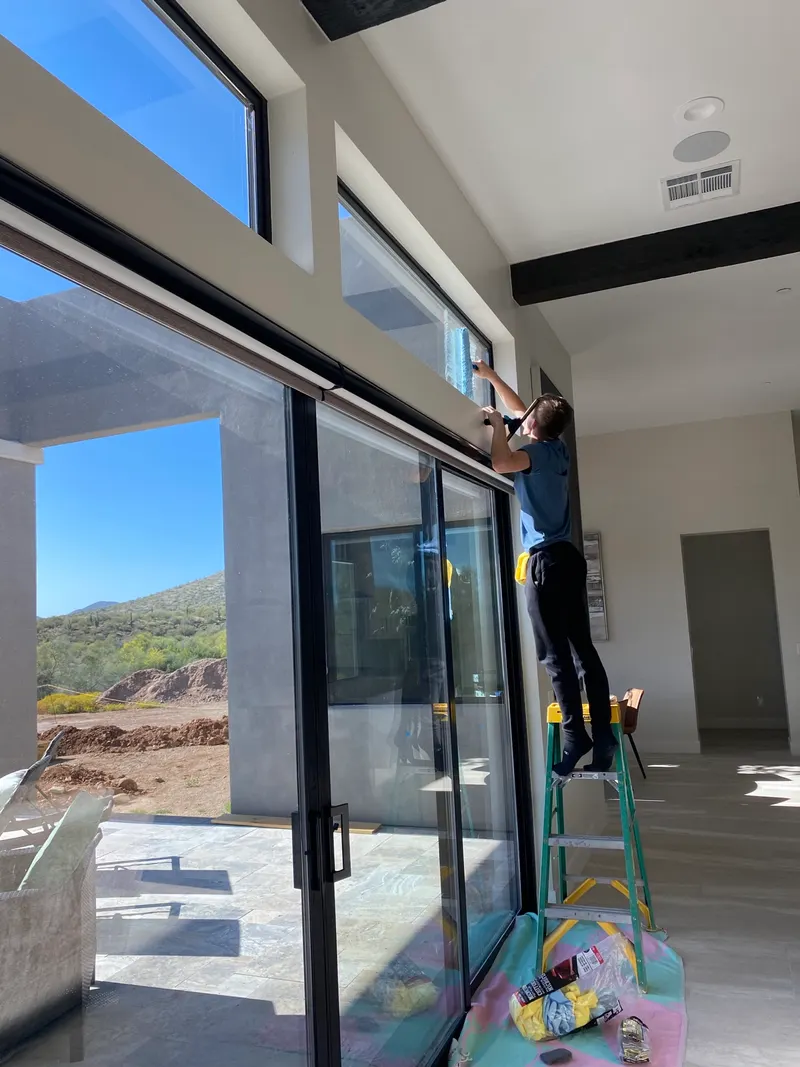
What the trades leave behind
Windows are the one surface in a new house that records everything that happened to it. Framing, stucco, paint, drywall and flooring all work around the glass, and nearly every one of those trades leaves something on it. By the time the last crew packs up, the panes that were meant to show off the house are usually the worst looking thing in the room.
Builders expect that, which is why the final window clean is treated as its own piece of work rather than part of a general sweep. It is not a wipe down. It is taking off a list of things that each behave differently.
- Manufacturer stickers and labels, plus the adhesive underneath, which gets harder the longer it bakes on a south or west facing pane.
- Paint and primer overspray, which usually lands as a fine speckle across a whole window rather than as one obvious drip.
- Stucco, plaster and mortar spatter, which dries on glass the same way it sets on a wall.
- Drywall mud and sanding dust, the finest residue on the site, which drifts into every track and ledge.
- Caulk and silicone smears, and the gum left behind by protective film and masking tape.
- Metal filings from cutting and grinding, which land hot and can bed into the surface.
- Concrete slurry and saw water that ran down the lower panes and dried there.
Some of that is light and lifts with water. Most of it does not.
Most of what a build leaves on a window is either stuck to the glass or hard enough to scratch it.
Why a wash will not do it
Routine window cleaning deals with soil that is sitting on top of the glass. Dust, pollen and rain spotting come off because they were never attached to begin with. Construction residue is attached. Adhesive has cured onto the pane, overspray has dried into a film, and spatter has set.
The second problem is the one that does lasting damage. Construction dust is not soft like household dust. Drywall sanding leaves gypsum behind, and masonry, stucco and concrete work leave sand and silica. Both are hard enough to mark glass when they get dragged across it. Wiping a dusty new window with a dry rag is one of the easiest ways to scratch it, and the marks tend to show up later as fine arcs running in the direction of the wipe.
That is why order matters on a post-construction clean. The heaviest residue comes off first, carefully, so nothing abrasive gets spread over a pane that has already been finished. Scraping hard carries its own risk, because some coated and tempered panes mark more easily than plain glass does. Anything that has cured too firmly to come off without risking the glass should be pointed out to you rather than forced.
The parts under the glass
Glass gets the attention, and the channels around it hold the actual problem. Fine dust settles into tracks and sills during the build, then the first hose or the first rain turns it into a paste that sets in the corners. A brand new slider that grinds in its first week is almost never a bad roller. It is a track full of construction debris, and the grit is wearing the hardware every time the door moves. Our post on why sliders and tracks stick in Arizona homes goes through what that debris does over time.
Screens are the other overlooked piece. On many builds they are fitted early and then left in place while the stucco and paint go on, so the mesh holds a layer of everything that was sprayed nearby. On others they sit stacked in a garage for months, collecting the same dust from the open side. Either way they need to come out, get washed and go back in, which is also the only moment anyone checks whether a frame got bent on site. Screens, tracks and sills is handled as its own part of the job for that reason.
When to clean new windows
After the messy trades are finished and before anyone needs the house to look finished. Paint, stucco, drywall and flooring all have to be done, because cleaning ahead of them means paying to clean the same windows twice. The clean then sits in front of the final inspection, the listing photos or the move-in, whichever comes first.
The practical way to schedule it is to work backward from the handoff date rather than forward from the last trade, since the last trade always moves. On a phased build, finished sections can be cleaned in stages so completed rooms stay completed.
Arizona adds a wrinkle. A new home usually sits on a graded lot with bare dirt around it, often next to other lots in the same state, and wind moves that dirt onto the nearest vertical surface. Glass cleaned while the site is still active can look dusty again quickly. That is a scheduling problem rather than a cleaning problem, and it is worth saying out loud before the date gets set.
What to check at sign-off
Whoever walks the house at the end is the last person who can catch anything. It takes a few minutes per room and needs no tools.
- Look at each pane from an angle rather than straight on. Flat light hides film almost completely, and low morning or late afternoon light shows it.
- Check the top corners and the edge of the glass where it meets the frame lip. Tape residue and spatter hide there.
- Run a finger along each track, especially into the corners, where a track that looks clear can still be packed.
- Slide every door and window once. Grinding means debris rather than a faulty roller, and it is easier to fix now.
- Look for scratches and chips and raise them during the walkthrough. Once the house is occupied nobody can say when a mark appeared.
- Count the screens, check the mesh for holes and the frames for bends, and make sure each one went back into the opening it came from.
- Check interior sills and the underside of the frames, which is where drywall dust settles and stays.
What a clean cannot fix
Some things on new glass are not residue and will not come off, and an honest answer before the work starts is worth more than an optimistic one afterward.
Scratches are the main one. If a blade or a dry wipe marked the pane earlier in the build, cleaning will make the mark easier to see rather than make it go away. A pane can also arrive from the factory with fine debris fused into the surface during manufacturing, which tends to show as specks or a faint haze in strong light and has nothing to do with the site at all. Heavy overspray that cured for weeks sometimes reaches the point where getting the last of it off would risk the glass more than leaving it. In each case the right move is the same: identify it, show it to the person signing off, and record it while there is still a conversation to be had with the builder.
The first season after move-in
New glass starts clean and then meets the Valley. Landscaping goes in within the first weeks and the irrigation is commissioned with it, often with heads throwing onto the lower part of the house. Hard water that dries on a pane in the sun leaves minerals behind, and those minerals bond harder the longer they sit. On a new house this is the easiest problem in the world to stay ahead of. On one that nobody has looked at in years, it turns into a treatment. Removing mineral deposits from glass covers how to tell surface film from etching.
Checking the spray pattern of every head near a wall, before the first summer, is the single most useful thing a new owner can do for their windows. After that it is a matter of rhythm, and maintenance plans exist for people who would rather not track it themselves.
Camelback Window Cleaning handles post-construction window cleaning for new builds and remodels, works Monday through Saturday, 7:00 am to 5:00 pm, and texts before arriving. The northwest Valley detail is on the Peoria and Glendale window cleaning page. When you know the handoff date and roughly how many windows are in the house, get instant quote with that and a photo or two of the glass.
Key takeaways
- Stickers, adhesive, overspray, spatter, caulk smears and construction dust all come off the glass separately, not in one wipe.
- Construction dust contains gypsum, sand and silica, so a dry wipe on a new pane is how scratches happen.
- Tracks and screens hold more build residue than the glass does, and grit in a track wears the hardware.
- Schedule the clean after paint, stucco, drywall and flooring, working backward from the handoff date.
- Scratches and factory debris in the glass are not residue and should be raised at the walkthrough.