

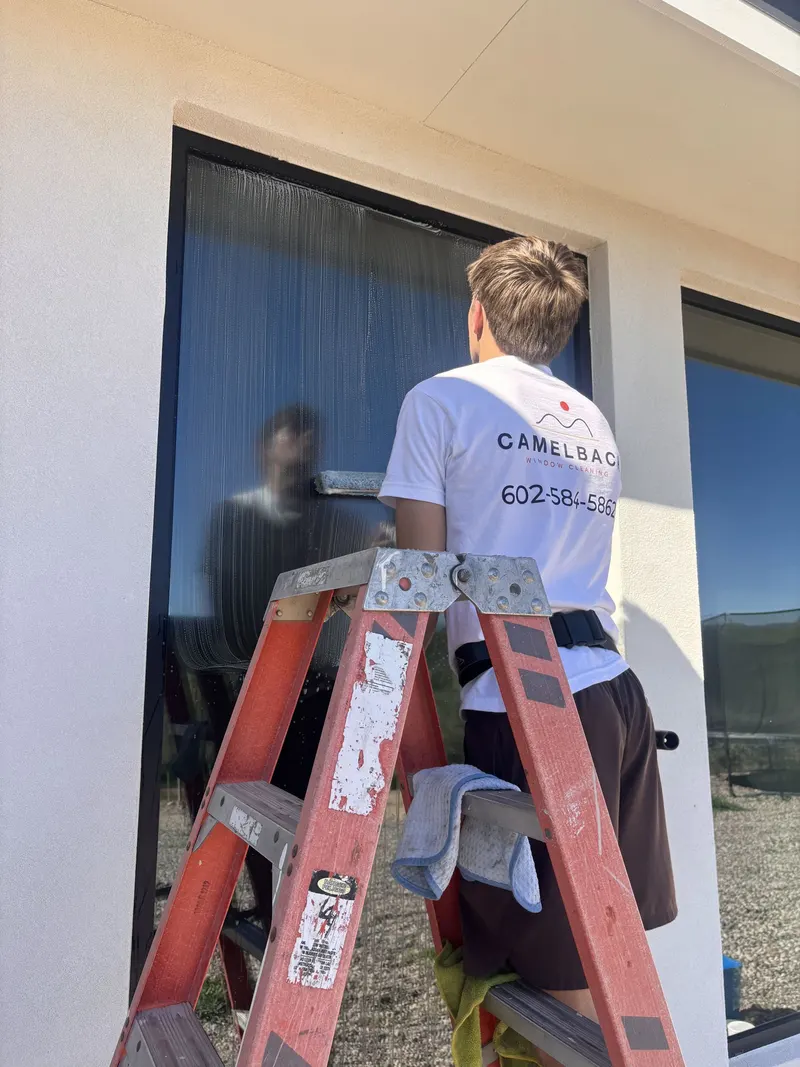
Why the glass dusts over
Fountain Hills is wrapped in open desert. The McDowell Mountains sit on one side and undeveloped land runs out from the edges of town, so there is not much between the wind and your windows. Yards here are mostly decomposed granite and native planting rather than lawn, which suits the setting and also means loose material sitting on the ground almost everywhere.
Wind picks that material up and puts it down on the first vertical surface it meets. On a house with a wall of glass facing the view, that surface is the window. The film goes on evenly and slowly, which is why people tend to notice it on a particular afternoon rather than on a particular day. The sun drops, hits the glass at an angle, and haze that has been building for weeks suddenly reads as dirty.
Rain does not fix it. A short desert shower wets the dust, runs it down the pane and leaves it there to dry in streaks. Glass often looks worse after the first rain following a dry, windy stretch than it did the week before.
Dust comes back with the wind. Mineral spots build up and stay.
Dust or mineral spots?
Two different problems land on the same pane and they need different answers. Dust is loose. It comes off with water and a clean pass, and it starts coming back on the next windy day. Mineral spots are bonded to the glass. They are what stays behind when a drop of hard water evaporates and the calcium and magnesium in it do not.
Out here the usual sources are irrigation heads that throw onto the lower third of ground-floor windows, and pool splash on patio glass. South and west faces bake the deposit on fastest, because the water dries almost as soon as it lands.
The test is simple. Wash a spotted area and let it dry. If the pane comes clear, you had dust and surface film. If pale rings or a cloudy patch stay behind, the minerals are bonded. Film can often be improved with a treatment. If the glass also feels rough under a fingertip or looks dull when you view it at an angle, the surface may be etched, and etched glass can only be improved, never returned to new. Our post on removing mineral deposits from glass goes through the difference in detail.
A check from the ground
You can work out most of what your glass needs without a ladder. Do it in early morning or late afternoon light, because flat midday sun hides haze almost completely.
- Stand at an angle to each window rather than square on. Haze shows up in the reflection, not through the glass.
- Look at the bottom third of ground-floor panes for pale rings. That is sprinkler range.
- Check patio and pool-side glass separately. Splash marks sit higher and come in clusters.
- Run a finger along the top edge of the frame and the ledge below the pane. Dust collects there first and washes down onto clean glass later.
- Push each slider. Grinding means the track is loaded with grit, not that the door is failing.
- Hold a screen up to the light. If the mesh looks dark and even, it is carrying dust.
- Note any cracked pane, failed seal or bent screen frame now, before anyone starts work on it.
Screens hold the dust
Screens are the part most people skip and the part that undoes the rest. Desert mesh loads up with fine dust the way a filter does, and the next breeze pushes some of it onto the pane you just cleaned. A screen can look fine from inside the house and still be holding a full layer of dust that only shows when you tip it against the light.
Taking screens out also tells you their condition. Stretched mesh, a bent frame or a corner that has pulled apart usually turns up on the driveway rather than in the window. Our guide on how to clean window screens covers the method and the mistakes that put a hole in the mesh.
Tracks go with them. Grit in a slider track is what wears the rollers, and in a house with a big patio door that door moves more than any window in the place. That is why screens, tracks and sills is treated as its own piece of work rather than a finishing touch.
How often out here
No single interval fits every house, and anyone who offers you one has not looked at your glass. Exposure decides it. A home up on a hillside with its view side open to the desert collects dust faster than a sheltered house down near Fountain Park with mature planting around it. South and west glass takes more sun and more baked-on mineral than north-facing panes do.
A practical way to set the rhythm is to pick the interval that keeps your main view windows from ever reaching the point where you notice them. If dust or spots are obvious again well before the next visit, the gap is too long. If the glass still looks clean when the crew pulls up, you can stretch it. Our Phoenix window cleaning calendar covers how the seasons move that line, and maintenance plans exist for people who would rather not track it themselves.
What to tell a cleaner
Fountain Hills lots make access the main variable. Building on a hillside means the ground under a second-story window is often not level, and on many homes the drop is on the view side, where the glass is biggest. A gate, a long driveway or a narrow hillside drive changes what equipment needs to come on the truck.
Say all of that at quote time and the visit runs properly the first time. Describe the tall glass, say what is underneath it, mention the gate and where a vehicle can park, and flag any irrigation zone that hits a window so nobody cleans a pane while the sprinklers run on it. Photos from the ground are enough to work from. Exterior window cleaning covers every pane, frame and ledge, and the access plan is what decides how the tall ones get reached.
Camelback Window Cleaning works Monday through Saturday, 7:00 am to 5:00 pm, and the crew texts before arriving. Local detail for the area is on the Fountain Hills window cleaning page. When you know roughly which panes you want covered, get instant quote with a couple of photos of the glass and the access.
Key takeaways
- Open desert on every side means wind-carried dust lands on the glass constantly.
- Rain does not clean desert dust off a window, it streaks it down the pane.
- Wash a spotted area and let it dry to tell loose film from bonded minerals.
- Screens left in place put their dust back on glass you just paid to clean.
- Exposure, not the calendar, should set how often your windows get cleaned.