

What changes out here
Cave Creek and Carefree sit where the Valley street grid runs out and open desert takes over. Houses here are built to face that. Big view glass, sliding walls onto a patio, clerestory panes set high to catch Black Mountain or the boulder formations around The Boulders and Rancho Manana. The glass itself is ordinary. What reaches it is different from what reaches a window in a built-up neighborhood further south.
Three things do most of the work on a pane out here. Dust comes off bare ground and unpaved surfaces. Debris and insects collect in screens, sills and tracks. Mineral film arrives with whatever water lands on the glass. Each one needs a different answer, and which ones you have decides how a visit gets planned.
Fine dust, webs and hard water reach glass faster at the edge of the desert than they do in town.
Dust off the road
Desert lots are not planted with lawn. The ground around a house is decomposed granite, native brush and rock, and past the property line it is open land that nobody waters. Dry ground gives dust up to the wind easily, and the first vertical surface downwind catches it. On a house built for the view, that surface is a wall of glass.
Driveways add their own share. Long drives in Cave Creek and the stretches north of Carefree are often gravel or graded dirt, and every vehicle that comes down one lifts a plume that drifts toward the house. A delivery truck, a horse trailer, a neighbor heading into town: the glass takes a little more each time. Homes set back from a dirt road usually show it worst on the side facing the drive.
Reaching for the hose rarely helps. Water moves that dust around the pane and then leaves it there to dry, so the glass often looks worse an hour later than it did before the rinse. If the water is hard, the rinse leaves mineral spots of its own on top of the dust.
What the desert leaves
Screens near open desert do more than keep insects out. They collect. Fine dust loads the mesh the way it loads a filter. Spider webs anchor in the corners of the frame. Wasps build in the sheltered spot under a patio ceiling or beneath the lip of a sill. Seeds, brush fragments and insect casings pile into the bottom channel of a slider.
That is why an exterior clean on a desert-edge home holds for less time when the screens stay in the window. Dust held in the mesh moves back onto the pane with the next breeze. Taking the screens out is also the only moment anyone sees a stretched panel or a corner that has pulled apart, which is common on frames that have spent years in full sun. Our guide on how to clean window screens covers the method and the mistakes that put a hole in the mesh.
Tracks matter for a different reason. Grit in a slider track grinds the rollers every time the door moves, and in a house with a patio wall that door moves more than any window on the property. That is why screens, tracks and sills is treated as its own piece of work rather than a finishing touch.
Where it collects
- The bottom channel of every slider and patio door, where seeds and gravel gather.
- Screen corners and the inside lip of the frame, where webs anchor first.
- Weep holes along the bottom of a frame, which pack with dust and hold water against the glass.
- Sills under high view windows, where dust sits until rain washes it down over clean panes.
- Ledges, beams and light fixtures above the glass, which drop what they are holding in the next gust.
- The sheltered face of a window near a patio ceiling, where wasps and spiders build out of the wind.
Water from a well
Mineral content varies from property to property out here. Some homes are on a town or small local water system and some draw from a private well, and what reaches the glass is whatever comes out of the hose bib or the irrigation line. When a drop of hard water dries on a hot pane, the water leaves and the calcium and magnesium in it stay.
What you are left with is a pale ring or a cloudy patch that washing does not lift. Sprinkler and drip heads that throw onto the lower third of a ground-floor window are the usual cause, along with a hose used on the glass on a summer afternoon. Spots that come back in the same place after every clean point at an irrigation head rather than at the weather. Our post on removing mineral deposits from glass goes through how to tell the two apart.
The practical step is to find the heads that reach glass and turn them down or point them away. That stops the next deposit from forming while hard water stain removal deals with what is already on the pane.
Access decides the day
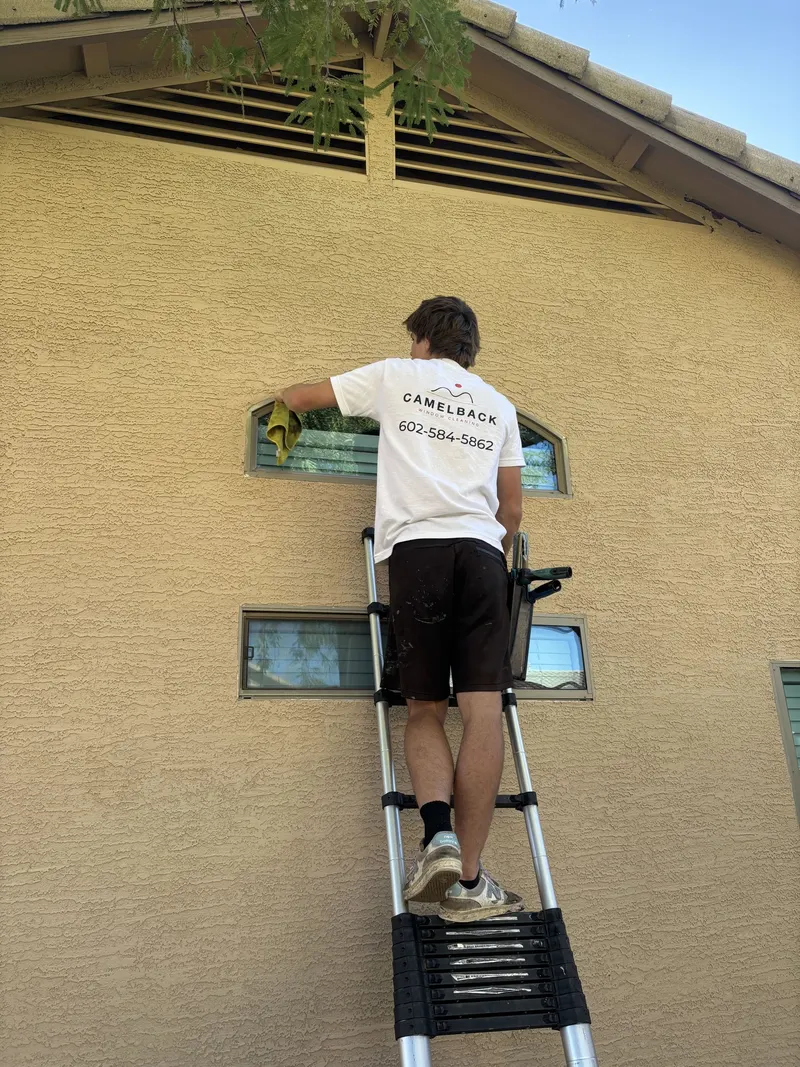
Lots out here are rocky and often sloped. A second-story window on the view side can have a boulder, a wash or a drop underneath it rather than level ground, and that changes what has to come on the truck. Gates, narrow drives, a turnaround that will not take a long vehicle and parking that sits nowhere near the glass all add time. Time that is planned is fine. Time discovered on the morning of the visit is what turns one visit into two.
Tall glass over uneven ground is the detail most worth describing when you ask for a quote. Our guide to two-story window cleaning covers what decides whether a pane gets reached from a ladder or from the ground.
Worth mentioning
- Where the drive meets the road, and whether it is paved, graded dirt or gravel.
- Any gate, code or guard station, and whether a vehicle can turn around at the house.
- Which windows sit above a slope, a boulder field or a wash.
- Whether the screens are in or out, and any panel already torn.
- Which irrigation zones reach glass, and the hours they run.
- Whether the house is on a well or a water system, if you know.
- Anything cracked, fogged between the panes or already repaired.
Booking a visit
Camelback Window Cleaning works Monday through Saturday, 7:00 am to 5:00 pm, and the crew texts before arriving. Exterior window cleaning covers every outside pane, frame and ledge. Interior visits use shoe covers and drop cloths. Screens come off, get washed and go back in, and tracks are cleared so the sliders glide again.
Local detail for the area, including the neighborhoods we cover from Tatum Ranch to downtown Carefree, is on the Cave Creek and Carefree window cleaning page. When you know roughly which panes you want covered, get instant quote with a couple of photos of the glass and one of the driveway, and you get a written scope back.
Key takeaways
- Bare desert ground and gravel drives put dust on the glass year round.
- A hose rinse spreads desert dust and dries it on the pane in streaks.
- Screens near open desert hold dust, webs and nests that move back onto clean glass.
- Pale rings that survive a wash are minerals and need a treatment, not more water.
- Access details decide how a visit on a boulder lot runs, so describe them up front.