

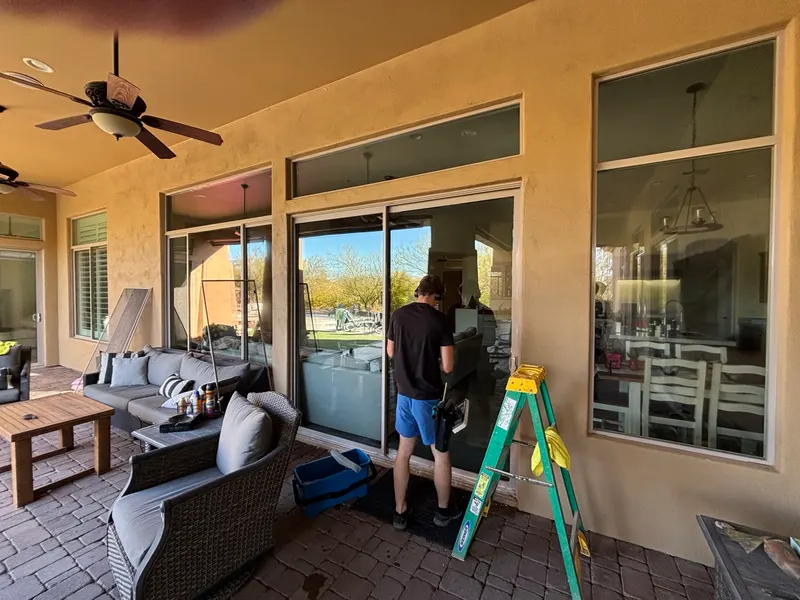
What changes out west
Peoria and Glendale cover a wide stretch of the northwest Valley, and the glass out there sits in a different setting than glass pressed up against open desert on the far side of town. Much of it belongs to newer homes in master planned communities like Vistancia, Westwing and Sierra Verde, built with big sliders and tall windows. Some belongs to lakeside and golf course lots around Arrowhead Ranch. And some is far older than either, in the bungalows of Old Town Glendale and Catlin Court.
The method does not change much from one of those to the next. What changes is what lands on the glass, how often it lands, and how much the window itself can take. Three things do most of the work out here. Dust comes off open land and building sites. Irrigation water comes off lawns and greenbelts. Afternoon sun bakes both onto the pane.
On a lawn lot, the spots along the lower panes usually start at a sprinkler head rather than in the weather.
Lawns put water on glass
A lot of the west Valley is planted. Front lawns, greenbelts between houses, park strips, golf course turf and the landscaping that comes with a master planned street all run on irrigation, and sprinkler heads throw further than most people expect. A head set in the bed under a window sends a fan of water across the bottom third of that pane every time the zone runs.
Valley tap water is hard, drawn from Colorado River and groundwater sources, so every drop that dries on a hot pane leaves its minerals behind. One cycle is invisible. A season of cycles builds a white haze along the lower panes and across the face of a slider, and washing will not lift it. If your lawn gets overseeded for the winter, the watering that follows runs more often for a few weeks, and the low glass is where you see it.
Irrigation spotting is easy to tell apart from weather once you know what to look at. Wind blown dust lands fairly evenly across a whole pane. A sprinkler leaves a band, an arc or a cluster of rings in the same place every time, and it stops at the height the head can reach. Our post on removing mineral deposits from glass walks through the test that tells you whether what you have is film or something deeper.
Where sprinkler spots show
- The bottom third of any ground floor window with a head in the bed below it.
- Patio sliders near the edge of a lawn, where the throw crosses the glass at an angle.
- Pool fence panels and low view glass that face turf or a greenbelt.
- Side and garage windows nobody looks at until the film has built up.
- Street side glass on a corner lot, where park strip heads run along the sidewalk.
- Anything downwind of a head on a breezy evening, which can be a story up.
The useful step is to walk the yard while a zone is running and find the heads that reach glass. Turning one down or pointing it away stops the next deposit from forming, which is what makes hard water stain removal hold instead of starting over at the next watering.
Dust off open land
North Peoria still has open desert and graded lots waiting on the next phase of building, and the west Valley gets steady dust off undeveloped land and construction. Dry bare ground gives dust up to the wind easily, and the first thing downwind catches it. On a newer home built for the view, that is usually a wall of windows.
Dust from a building site is harsher than the dust off a yard. Cutting, grinding and stucco work put fine mineral particles in the air, and once they sit on glass through a few rounds of dew and sun they hold on far better than ordinary grit. If the heavy work is still going on across the street, it is worth letting it finish before booking a full clean. Our guide to what post-construction cleaning removes covers what that residue takes.
Reaching for the hose in between rarely helps. Water pushes fine dust around the pane and then dries it there in streaks, and if the water is hard it adds spots of its own on top. Clearing the sills, screens and tracks does more for the view than spraying the glass does.
Old Town Glendale glass
The bungalows around Old Town and Catlin Court are a different job from a recent build in Vistancia. Older frames, smaller panes, divided lights and wood that has been painted more than once mean many more edges for the same amount of glass, and less tolerance for pressure. Old putty and single pane glass ask for a lighter hand, and the screens on a house that age are often original and brittle.
Say how old the home is when you ask for a quote. A visit to a house with divided lights is planned around the condition of the frames, and it runs on a different clock than a wall of sliders does.
Sun on the view glass
Afternoon sun does two things to a west Valley window. It heats the pane, so water that lands late in the day dries fast and leaves behind whatever it was carrying. Then it comes in low and rakes across the glass at the hour people are home, which is when a film that looked fine at noon turns the view milky. Glass facing open country toward Lake Pleasant and the ridgelines gets both at full strength.
Timing matters for the same reason during a clean. Glass worked in full sun dries before it can be pulled off properly, so shaded walls and early hours give better results. Exterior window cleaning covers every outside pane, frame and ledge, and the order the walls are done in on a hot day is part of planning the visit. Tall glass over a patio or a two story great room adds its own access questions, which our guide to two-story window cleaning goes through.
Worth mentioning up front
- Which irrigation zones reach glass, and the hours they run.
- Whether a build is going up nearby, and how close it is.
- The age of the home, and whether the windows are original.
- Any divided lights, leaded panes or painted wood frames.
- Gate codes, HOA rules about hours, and where a vehicle can park.
- Screens that are torn, stretched or already out of the frame.
- Solar panels, if you want them looked at in the same visit.
Booking a visit
Camelback Window Cleaning works Monday through Saturday, 7:00 am to 5:00 pm, and the crew texts before arriving. Screens come off, get washed and go back in, and tracks are cleared so the sliders glide again. Interior visits use shoe covers and drop cloths. Minerals are treated as their own piece of work, since more washing will not move them.
Dust settles on panels the same way it settles on glass, so solar panel cleaning is often paired with a window visit on a west Valley home. Neighborhood detail, from Vistancia and Arrowhead Ranch to Old Town, is on the Peoria and Glendale window cleaning page. Once you know roughly which panes you want covered, get instant quote with a few photos of the glass and you get a written scope back.
Key takeaways
- Lawn and greenbelt sprinklers put hard water on the lower panes year round.
- Sprinkler spotting repeats in the same band, while wind dust lands evenly.
- Open land and nearby building sites keep fine dust moving onto west Valley glass.
- Older frames around Old Town need a lighter hand than a new build does.
- Low afternoon sun bakes film onto hot glass and then shows every bit of it.