

Where the Valley turns
Anthem sits against Daisy Mountain at the north end of the Valley, with family streets and a golf course community beside it. Tramonto and Sonoran Foothills climb the slopes above, built for the long views, which means walls of glass facing out and panes well above head height. Deem Hills, Stetson Valley, Stetson Hills and Arroyo Norte are newer stucco neighborhoods on flatter ground, and Norterra is built around shops and offices.
Glass gets washed the same way in all of them. What moves from one street to the next is what lands on the pane, how often it lands, and how far off the ground it sits. Those three things shape a visit far more than the cleaning itself does.
A hillside house does not have dirtier glass than a flat lot. It has glass that is harder to stand in front of.
Dust off open ground
The northern edge of the Valley still has open desert between the subdivisions, along with washes, undeveloped parcels and pads graded for the next phase of building. Bare dry ground gives dust up to the wind without much help, and whatever stands downwind catches it. On a house built for the view, that is a wall of windows.
Dust off a building site behaves differently from dust off the desert. Cutting, grinding and stucco work put fine mineral particles in the air, and once those sit through a few rounds of dew and morning sun they grip the glass harder than ordinary grit does. Our post on what a dirt lot nearby does to Phoenix windows goes through what to expect while the work is still going.
Reaching for the hose in between rarely helps. Water pushes fine dust around the pane and then dries it there in streaks, and hard water leaves spots of its own on top. Clearing the sills, screens and tracks does more for the view than wetting the glass does.
Water from turf and pools
Not everything up north is gravel. A golf course community keeps turf green year round, park strips and front lawns run on sprinklers, and pool decks sit right against low glass. Sprinkler heads throw further than people expect, and a head set in a planter bed under a window sends a fan of water across the bottom of that pane every time the zone runs.
Valley tap water is hard, so each drop that dries on a warm pane leaves its minerals behind. One cycle shows nothing. A season of cycles builds a pale band along the lower glass that washing will not lift. The pattern is the giveaway, because a sprinkler marks the same place every time and stops at the height the head can reach, while wind dust lands fairly evenly across the whole pane.
Walk the yard while a zone is running and find the heads that reach glass. Pointing one away stops the next deposit from forming, which is what lets hard water stain removal hold instead of starting over at the next watering.
Glass on three floors
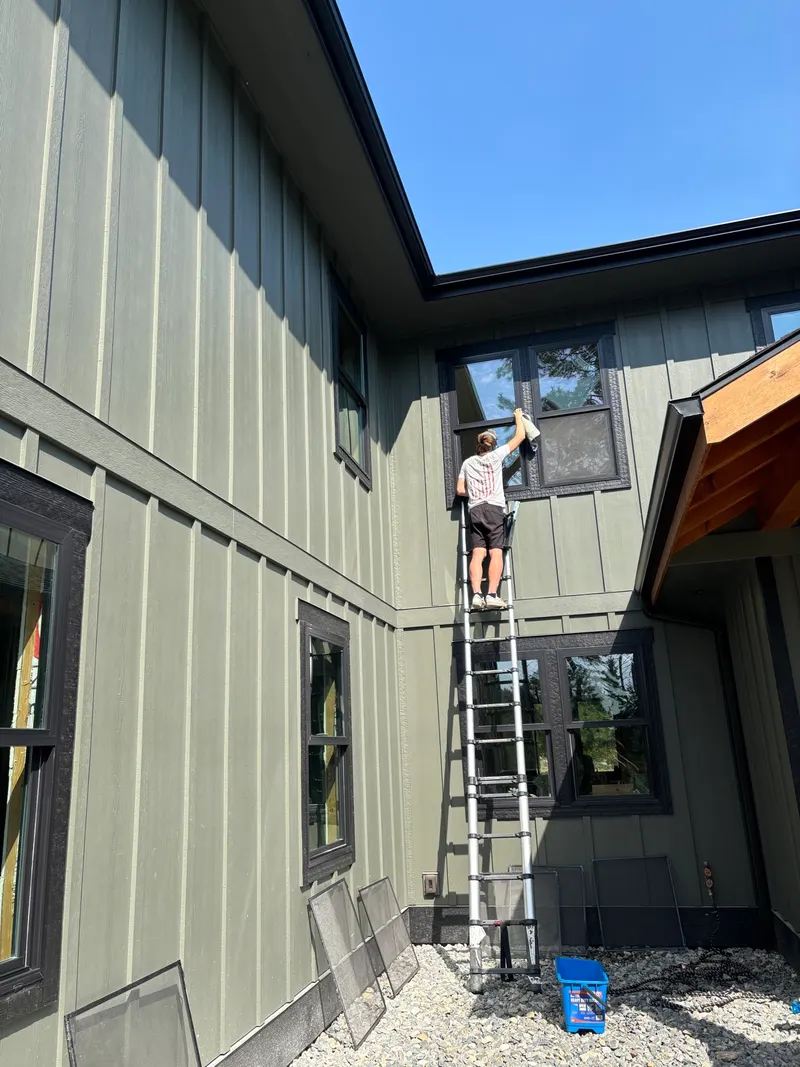
A hillside lot puts a house on more than one level, and the rooms built for the view get the tallest glass. Great room windows run up two stories, clerestory panes sit above a slider, and a wall that is easy to reach from inside can be a long way off the ground outside. Stepping back from a window on a slope often means stepping onto a retaining wall, a boulder, or nothing at all.
So a visit to a foothills house gets planned rather than guessed. Where a ladder can stand, whether the ground behind it is level, and which panes have to be reached from above instead of below are settled before anyone arrives. Our guide to two-story window cleaning covers how that gets worked out safely.
A photograph taken from the yard carries more of this than a description does.
- How many floors of glass the wall carries.
- Whether the ground below the window is level, sloped or built up.
- What sits underneath: gravel, a retaining wall, a boulder, a planter or a pool.
- Whether a vehicle can get close to that side of the house.
- Any pane that cannot be seen from the ground at all.
Newer panes, bigger walls
The flatter neighborhoods are mostly recent stucco builds, and newer homes came with larger panes and more sliding glass than older Valley houses did. Fewer frames and more open glass is quicker work per window, but a single mark shows across a wide surface, and a slider takes hands along the bottom and dust across the top at the same time.
Screens do more to the glass than people expect. A screen holds a layer of dust in its mesh and hands it back to the pane on the next breezy day, so a window behind a loaded screen clouds over again quickly. Screens come off, get washed and go back in, and tracks are cleared so the sliders glide. Our post on solar screens and window cleaning explains how the heavier mesh changes the job.
Norterra storefront glass
Plenty of the glass around Norterra belongs to a business rather than a house. Entry doors take hands all day, street facing panes take road dust, and the hours someone can work on them are set by when the doors are open. Storefront and small commercial cleaning gets scheduled around that.
What to tell a cleaner
A quote on a foothills house is only as good as what it knows about the house. Most of it is detail a homeowner can see from the driveway.
- Which floors the glass is on, and what the ground below it looks like.
- Whether the lot backs to open desert, a wash or a graded pad.
- Which irrigation zones reach glass, and the hours they run.
- Whether there is turf, a pool deck or a fairway on any side.
- Gate codes, HOA rules about hours, and where a vehicle can park.
- Screens that are torn, stretched or already out of the frame.
- Any pane with a pale band or ring that survives a wash.
Booking a visit
Camelback Window Cleaning works across North Phoenix and Anthem, Monday through Saturday, 7:00 am to 5:00 pm, and the crew texts before arriving. Exterior window cleaning covers every outside pane, frame and ledge. Interior visits use shoe covers and drop cloths. Minerals are treated as their own piece of work, because more washing will not move them.
Neighborhood detail, from Norterra and Tramonto up to Anthem Country Club, sits on the North Phoenix and Anthem window cleaning page. Once you know roughly which panes you want covered, get instant quote with a few photos of the glass and the ground below it, and a written scope comes back.
Key takeaways
- Open desert and graded pads keep fine dust moving onto northern Valley glass.
- Turf, park strips and pool decks put hard water on the low panes.
- A sprinkler marks the same band every time, while wind dust lands evenly.
- On a hillside lot, access is the planning question rather than the cleaning.
- A screen full of dust hands it straight back to the pane behind it.