

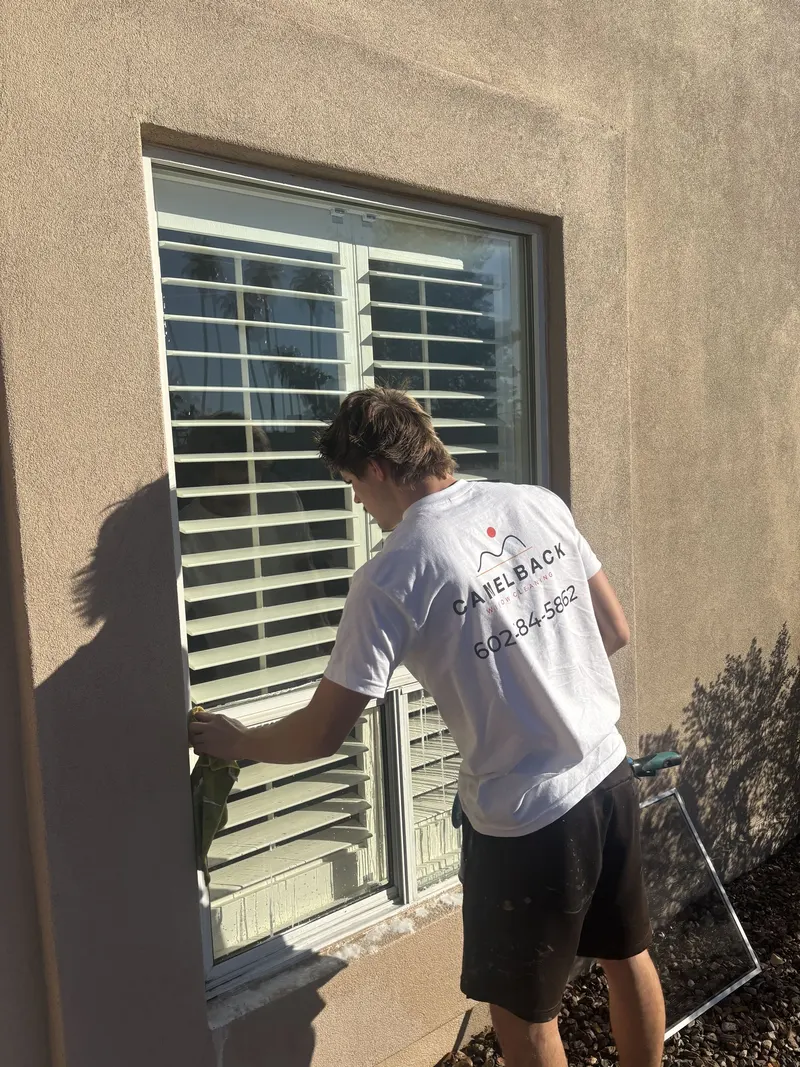
Where storm mud comes from
A long, soaking storm does something to a house that a short shower does not. A burst of rain wets the glass and dries off it. Rain that runs for hours saturates the ground and sets everything loose around the house moving. By the time it clears, most of what is sitting on the window arrived from somewhere other than the sky.
Three supplies do nearly all of it. Soil and decomposed granite get thrown up off the ground when drops land on standing water. Dust already in the screen mesh turns to mud and runs. And whatever has collected on the wall and roof edge above comes down the face of the house with the runoff.
That is why the marks are never spread evenly across a pane. They sit low, they run in vertical lines, or they gather under one corner of the roof. The pattern tells you which of the three you are dealing with.
Most of what a storm leaves on a window did not fall onto it. It was thrown up from the ground or came down the wall above.
The band along the bottom
Once the ground has dried, look at the lowest part of a window on the side of the house that faces open soil. The grit is heaviest within a hand width of the sill, thins going up, and stops at a fairly clear line. Above it the glass can be almost clean.
That is splash. A drop falling onto saturated ground does not soak in. It lands on a film of water already there and throws part of that film back into the air with soil in it. Gravel and decomposed granite do not stop that, they only change the size of what gets thrown. Anything within the short throw takes the hit, which on a house means the bottom of the glass, the sill, the frame and the lower wall.
Bare ground throws the most, which is why the worst windows are the ones over a planter bed, a strip of dirt beside the drive or a patch where the rock has thinned and the soil shows through. A deeper layer of gravel takes the impact instead of the glass.
What water does to a screen
A screen is a fine grid, and a Valley screen is never empty. It holds dust between cleanings, which is the whole reason window and screen cleaning belong in the same visit. A storm does not rinse that dust out. It wets it.
Wet dust stops behaving like dust. It becomes a thin mud that bridges the openings in the mesh and dries there as a sheet. A screen in that state reads darker than the ones beside it from the street, and the breeze that used to carry a little of the dust off no longer gets through.
Water running through a loaded screen also has to leave somewhere. It gathers at the bottom rail and drips, which is where the dirty line across the sill and lower pane comes from. Take a screen off after a storm and the proof is on the panel: the mesh washes clean across most of its area and stays dark along the bottom edge where the water collected.
Tracks and blocked weep holes
The track is the lowest point of the opening, so everything the storm moves ends up in it. Grit washes along the channel and settles where the water slows, usually in the corners and against the weep holes in the outer rail.
Those weep holes are how the frame drains. Blocked, the channel holds water instead of letting it out, and the grit sitting in it stays wet and packs harder than it ever would dry. The slider gets heavier, the rollers ride on debris rather than on the track, and the next storm adds to a channel that never emptied. Our guide to why tracks and sliders stick covers the cleaning itself.
The weeps are the small slots along the outside of the bottom rail. Water still standing in the channel a day after the rain stops means something is in the way of them.
Runoff from the wall above
The third supply comes down the wall. Water sheets off the roof edge and runs down the stucco, carrying whatever has collected up there since the last rain. Where that runoff crosses a window it leaves a vertical track on the glass and a heavier deposit on the sill, usually under one corner rather than across the whole opening.
Stucco adds something of its own. A wall surface is slightly rough and slightly chalky, and water moving across it picks up fine particles and dissolved mineral and carries both onto the pane. Once that water evaporates, the mineral stays behind. What is on the glass then is no longer mud, it is a spot, and why windows look worse after rain works through what happens as the water dries.
Hillside lots give the runoff more to carry. Homes set against the slopes, like many on the Paradise Valley side of the mountains, sit below ground that drains toward them, so water reaching the walls has crossed more open soil.
When to clean after a storm
The urge is to go out with a hose the moment the sky clears. Waiting is better, for a plain reason. The ground is still saturated and still moving, so glass cleaned while the soil is wet gets the same band thrown straight back by the first gust or the next shower.
Give the ground a few dry days and let the wind settle. Mud on a pane looks worse in the meantime, but it is not doing anything to the glass while it waits, and it releases cleanly once it is soaked again. A dried mineral spot behaves the other way around.
One exception is worth acting on sooner. Anything that is more than soil, such as fertilizer carried out of a bed or material washed off a work site next door, can mark a surface on its own. Rinse that off rather than leaving it to dry.
What to do before a visit
None of this is the clean itself. It is the part that decides how much work the clean turns into, and it takes one walk around the house.
- Walk the outside once and note which windows took a splash band low down and which took runoff from above.
- Look for standing water in the bottom track a day after the rain stops, which points at a blocked weep hole.
- Hold off on dry wiping anything. Grit dragged across dry glass is how a pane gets scratched.
- If a window has to be dealt with now, soak it, give the mud a minute to release, then rinse it off instead of rubbing it.
- Leave the screens alone rather than hosing them in the frame, which pushes mud through the mesh onto the glass behind it.
- Clear or deepen the gravel under the worst window so the next storm has less loose soil to throw at it.
What to ask a cleaner for
A visit after a storm is not quite a standard window clean, and the difference is in what else comes off besides the glass.
- Screens taken off and washed rather than rinsed in place, then put back once everything is dry.
- Tracks and sills cleared, with the weep holes checked so the channel actually drains.
- Frames and ledges included, because the splash band sits on the frame as much as on the pane.
- Enough water used on the lower panes to float the grit off before anything is pulled across the glass.
- A read on whether what is left is still soil or has become a mineral spot, since those are two different jobs.
Camelback Window Cleaning handles most of that under screen, track and sill cleaning: screens come off and get washed, tracks are cleared of grit so sliders glide, and sills are wiped so the frame matches the pane. The exterior clean covers every pane, frame and ledge, which is where the splash line lives.
Booking the visit
A storm is a fair reason to book a clean even if the glass was done recently, because what the weather left is not the ordinary film that builds up between visits. And if it is being done anyway, having the screens, tracks and sills done in the same visit is worth more after a storm than at any other time, since all three are carrying the same load.
The crew texts before arriving, and the instant quote on the site comes with a written scope so you know what is included before anyone turns up.
Key takeaways
- Most storm mud is soil thrown up from the ground or carried down the wall, not dirt that fell with the rain.
- A band of grit along the bottom of a pane is splash, so the worst windows sit over bare soil or thin gravel.
- Wet dust inside a screen turns to mud, bridges the mesh and drips a dirty line onto the sill below.
- Grit packs against the weep holes in the bottom track, so the channel holds water and the slider gets heavy.
- Never wipe a gritty pane dry. Soak it, let the mud release, then rinse it off.