

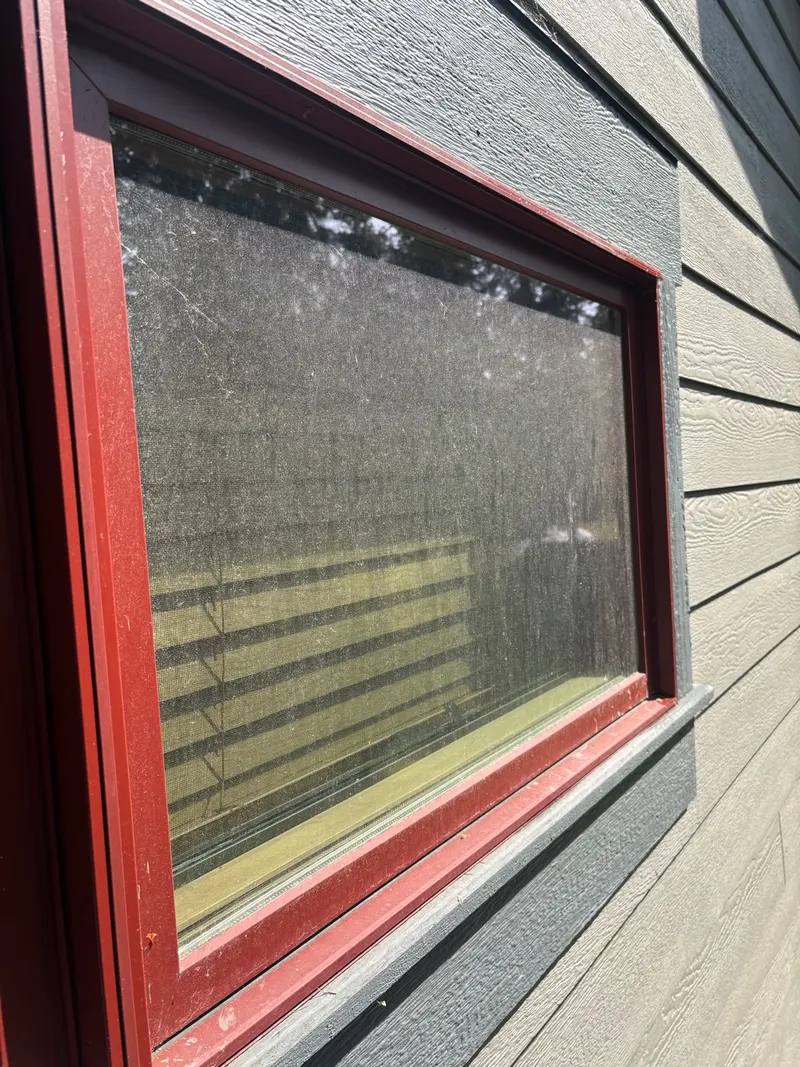
Which side is the mark on?
Before guessing at a cause, settle which surface the mark is sitting on. Put a fingertip against the outside of the glass beside the spot. If your fingertip and the mark look like they are touching, the mark is on that face. If there is a visible gap between them, you are looking at something on the inside, or at something sealed between two panes.
This one step rules out most of the list in a few seconds. Outside marks come from weather, water, soil, plants and anything that got sprayed near the house. Inside marks come from cooking, soot, dust moved around by the air handler and whatever was last used to clean the glass. A film on the inside face has its own set of causes, which interior glass haze covers in full.
A mark that will not move when the glass is wet is not dirt sitting on the pane.
Does it move when wet?
Wet a small patch and watch what the water does. Loose dust goes dark, lifts and runs. A mineral mark stays exactly where it was and often disappears while the glass is wet, then reappears as the water dries. Sticky residue smears into a wider haze instead of lifting. A hard speck of paint or stucco sits proud of the surface and the water runs around it.
Run a fingertip across the dry pane at a low angle too. Flat and smooth means whatever is there is thin. A texture you can feel means a deposit with some body to it, or a surface that has been damaged. Do not scrub a dry pane to find out. Dust in the Valley carries grit, and dragging a dry cloth over it is one of the common ways glass picks up fine scratches.
- Lifts and runs when wet: airborne dust or soil film.
- Vanishes wet, returns dry, in rings or runs: dried water, usually mineral.
- Smears wider instead of lifting: sticky residue from a plant or a cleaner.
- Sits proud of the glass and water runs around it: paint, stucco, texture or adhesive.
- Nothing on either face changes it: a scratch, an etched patch, or failed glass.
Where does it sit on the pane?
Position narrows it further. An even cast across the whole pane, heaviest low down, is settled dust. Marks gathered along the bottom foot of the glass usually arrive from ground level, thrown up by irrigation, a hose, a pool deck or rain splashing off hard surfaces. Marks concentrated at the top, running downward in tails, came off the wall, the frame or the roof above.
Pattern matters as much as position. Tight rings mean drops landed and dried in place. Long vertical runs mean water sheeted down the glass carrying whatever it picked up. A band of small dark dots under an eave or beside a porch light is insect spotting, not water.
Marks that fall from above
The wall above a window feeds the glass below it. Stucco sheds a chalky powder as it weathers, and the first hard rain after a dry stretch carries that powder down the pane in streaks. Dirt collected in a window frame does the same thing in miniature, which is why so many panes show a dirty tail below each corner of the frame.
Sealant is the one people rarely guess. A bead of caulk along the head of a window softens in heat, and a clear or amber residue can creep down onto the glass below it. It reads as a greasy streak that water will not touch and that comes back in the same place every summer. Rain makes all of this obvious at once, which is why windows so often look worse after a storm than before it. Our post on rain spots in Arizona explains why the first rain is the worst one.
Specks, droppings and sap
Insect spotting shows up as small dark points, usually clustered where a light burns at night or where an eave gives shelter. The points are tiny but they stick, and they will not come off a dry pane without a fight. Softening them with water first and lifting them with a soft edge works. Picking at them dry does not.
Bird droppings dry hard and fast in this climate, and the longer one sits in full sun the harder it gets. Soak it, give it time, then lift it. Never dry scrape a dropping off glass, because the grit inside it is doing the scraping. Trees add a quieter problem. Glass under a mesquite, a palo verde or a citrus often picks up a faint sticky film, and every bit of passing dust then sticks to it. The pane looks dirtier than its neighbors on the same wall for no obvious reason.
Paint, stucco and sealant
Any work done near the house ends up on the glass. Spray painting a fence, patching stucco or re-coating a roof throws a fine mist that carries further than people expect. It lands as a scatter of hard specks that look like dirt until you try to wipe them off. Overspray needs a careful mechanical lift rather than a wash, and the older it is the more patient that work has to be.
New glass has its own version. Labels, adhesive, mortar splash and plaster dust are the standard list after a build or a remodel, and they want handling in a particular order. That is a job of its own, and the post on what a post-construction clean removes walks through it.
What will not wash off
Some marks are in the glass rather than on it. Long-running sprinkler overspray can leave a surface that stays dull after every mineral deposit has been treated, and at that point cleaning can improve the look without taking it back to new. Fine scratches do the same thing in a different pattern, usually in arcs where something was wiped in circles. Both show up most clearly in low morning or evening sun.
A haze that sits between two panes is a third case. No amount of work on either face will reach it, because the mark is inside a sealed unit, and the fix is glass work rather than cleaning. Anyone quoting on your windows should be willing to say out loud which marks will come off, which will improve and which will not move. If hard water does turn out to be the culprit, the guide to removing hard water stains covers what responds and what does not.
How fast does it come back?
Return time is the last clue, and it points at the source rather than the mark. Film that is back within days is airborne, and something nearby is supplying it: a dirt lot or a graded pad, an unpaved lane, a wash that runs dry most of the year. Film that takes months is ordinary settled dust. Spots that appear on a schedule are being delivered on a schedule, and sprinkler timers are the usual answer.
That difference decides what to do next. A supply problem is worth fixing at the source, by moving a sprinkler head or shutting off a misting line that drifts onto glass. A weather problem is worth timing a clean around instead. Out in boulder country the supply tends to be the desert itself, and homes around Cave Creek and Carefree sit with open ground on at least one side of the house.
What to tell a cleaner
Say what you see and where, and the visit gets scoped properly before anyone arrives. A pane with mineral deposits, a pane with overspray and a pane that is simply dusty are three different pieces of work, and only one of them is a wash.
- Which windows carry the marks, and which side of the house they are on.
- Whether the mark is on the outside, the inside or between the panes.
- What the mark does when it gets wet.
- Anything sprayed, painted, patched or re-roofed near the house recently.
- Where the sprinklers, misters and pool are in relation to the glass.
- How long the glass stays clear after a clean.
Photographs help more than descriptions. Shoot each problem pane with the sun low and off to one side, because flat midday light hides almost everything on glass. Camelback Window Cleaning says up front which marks will improve and which will not, and exterior window cleaning covers every pane, frame and ledge, with hard water stain removal scoped separately where the deposits call for it. Send photos of the worst panes with your instant quote and say which marks bother you most.
Key takeaways
- Find out which surface the mark is on before guessing at a cause.
- Wetting a small patch separates loose dust from mineral, sticky residue and hard specks.
- Position and pattern name the source: low marks splash up, high marks run down.
- Insect spotting, droppings and tree residue all need softening, never dry scraping.
- Scratches, etched glass and haze inside a sealed unit cannot be washed off.